
Harvest
sowing and reaping

[n.b. If you previously signed up for my Tau newsletter, this is it.]
You reap what you sow, except when you don’t. My wife, Laura, was taking her daily swim in the August waters of coastal Maine, which peaked at a cool 58-degrees on the surface, when she called to me from the channel waving a very large and beautiful shell in her hand. “Look at this,” she yelled.
“Is it whole?”
“Yes, it’s whole.”
“La, that’s a scallop!”
“Really?”
“Yeah, I’d know it anywhere. It’s, like, an ancient Christian symbol for pilgrimage. You know this. LOL.”
“I found it deep at the bottom, just past the low tide line. There are tons of them down there. It’s like a graveyard of scallops.”
“But are they dead?”
Just then the scallop in her hand clapped it’s gape open and shut. Laura squealed in delight then started laughing.
“Bring it in and let me take a look at it,” I said. “Maybe we could eat it. Scallop sashimi on the beach!”
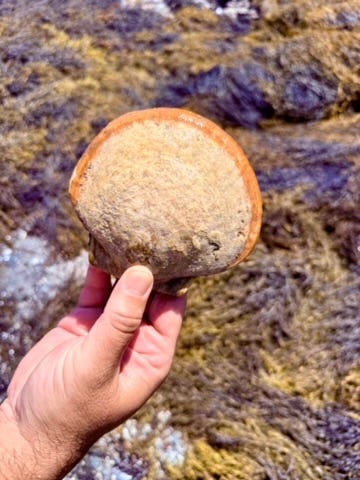
After verifying it was indeed a live adult scallop, I dove in to find more. I’d mostly been going in the water at high tide –– the tidal range is about eleven feet at the Eggemoggin –– because I liked swimming underwater through the kelp imagining I was a seal in Monterey Bay, and because I could jump from the slate promontory straight in. At low tide you had to walk way out over rock and shells. But sure enough, a little way past the intertidal zone, at low tide, there was a long bed of various crustaceans, shell detritus, and scallops about twelve to fifteen feet down. With Laura’s swim goggles and nothing else, I was able to retrieve nine large specimens before I started feeling mildly hypothermic. We lay them out on the rocky shore and began excitedly researching that this was okay to do.
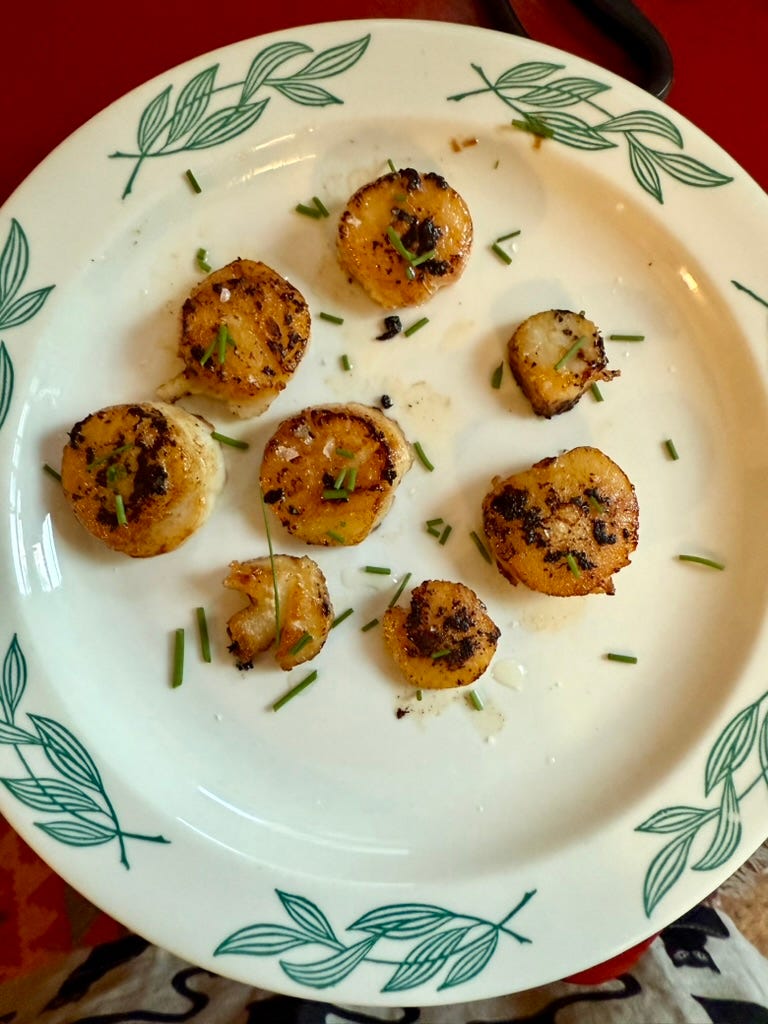
I learned from local fishermen that, while I should not perhaps make a habit of it without some sort of license, this small batch was probably okay, and that what we were doing was called “scallop harvesting.” What a lovely phrase –– as if I’d planned, prepared, planted, and tended a fall crop of apples like I used to watch my grandfather do in his Washington State orchards. But I hadn’t sown anything. All I’d contributed was the ability to swim, cold water tolerance, and grateful excitement. The scallop “harvest” continued as I took them in to clean, store, and prepare them for that evening’s appetizer. I did not create the conditions that made those scallops; I only reaped the gift. They were infinitely more tasty and delightful than when purchased at $40/lb. from the grocery store, by the way.
But sometimes you sow and sow for years and years and, for various reasons nefarious or ordinary, the crop is not yours to reap. The tree gets rot. The market demand shifts. A theft occurs. You get injured. Someone starts a war. The children never rise up and call you blessed. No one wants to pay for music.
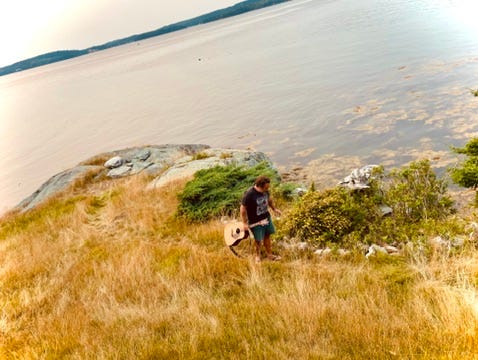
Because on the day I harvested this bounty of free ocean sustenance I also received and listened to the final version of my new album, The Wheel. Seven years since my first furtive album, a lifetime as a singer-songwriter (often in privacy), initial inspiration, careful crafting and study, rewrites, hopes and dreams, profound emotions alchemized into pleasing harmonics, field recordings and compositions I’d saved for the right moment, the stellar and generous contributions of my team of recording professionals, years of frustrating delay as we scraped to find approximately $10,000 of our own money, and we’ve finally produced a beautiful and moving album. (For reference, a quality independent album done professionally generally costs $30K or more –– our sparing production was due to unique and unrepeatable circumstances, primarily the generosity of my friends.) Listening to the album from beginning to end in the tall, yellow grasses spangled by sunlight –– this moment was a harvest like no other.
What can I expect to reap from it? Nothing tangible, most likely. My religious tradition generally teaches a basic law of the harvest: that actions good or ill in one season lead to consequences in a later season, good or ill. But down on the ground, in this life and world, we know it doesn’t always work like that. Wisdom knows there are too many exceptions to justice, to things working right, to fair investment and reward. Often others reap what they haven’t sown.
With The Wheel I find myself in possession of a costly, unique, personal and precious creative-artifact to share. But easy consumption, disposability, attention deficit, celebrity, commoditization, corporate exploitation by all of the institutions involved in the streaming era of music, and so on, have created a culture in which –– according to a broad study by Catherine Harrison, president of the leadership and mental health consultancy Revelios –– no one wants to give the laborer their reward: “Society at large knows, consciously or subconsciously, that it cannot live without music. It’s in soundtracks, commercials, road trips, weddings. And yet we don’t want to pay for it. We expect this thing that is so fundamental to our lives to just be there in the ether for our use whenever we want.” We’ve unleashed a rapacious want, with an assumption of endless renewable resources. Or as a wise guide from my trauma treatment center said to me of America more broadly, “The problem with us is everyone only wants to reap, always.”
I am kvetching a little, it’s true. But to be honest I get tired of my own sad-boy routine. I’d like to try to surf the seasons a little more confidently going forward. You know, take the losses with the wins. Sow for the dignity and exhilaration of being a sower. Receive the gifts when they come, with joy. Prune bitterness when I don’t get return on my investments. Practice some faith, some hope, and some love. What if instead of treating my music, my creations, my entire life and vocation as my hard-earned fruit to enjoy (or to sell to someone in need of it for maximum profit), I reckoned these resources –– these gifts of occasion and earthly and spiritual bounty, plus my own talent and hard work –– as new seeds to sow? What if I considered ways to deeply share before I eat out all of the fruit’s flesh, suck out all its juice, and throw away the rind? What if we all tried to sow our little harvests back into others, into the environment, the culture, the world, in a kind of regenerative (agri-)culture?
This imaginative experiment feels it could be kind of punk rock in reality. My Grandpa John was punk for planting seeds into black earth and trusting a miracle to grow from it. When I feel even a little bit of a rock-and-roll mood inside myself, I relish the likelihood that Mammon sheds a tear every time a true gift is exchanged. Whether unearned scallops or the work of a lifetime, perhaps unexpected deliciousness lies in personally sharing your harvest with others, giving delight.
If you wanna stay where the scallops are gifted to you and not think about things like this I understand, but this is a piece I found really interesting which touches on your themes of reaping without sewing and about the US being an “extraction economy” rather than a "building economy" and the growing effects of that. It's very nuts and bolts about how the things participants of the American economy are doing that supposedly make us more money is not even making us materially richer - https://kyla.substack.com/p/from-dollar-dominance-to-the-slop
thank you for this, dear JWG. xo